
Analysis of how a weakening Atlantic current became the missing variable in Europe’s most consequential trade deals
Between 2024 and 2026, the European Union finally sealed the trade deals it had spent decades trying to reach. In the span of roughly two years, the EU ratified or concluded landmark agreements with India, Mercosur (the South American trading bloc comprising Brazil, Argentina, Uruguay, and Paraguay), and Indonesia – three of the most consequential deals in its history, covering economies that together represent nearly a third of global GDP and over two billion people.
The geopolitical logic was sound.
The EU-India agreement was always more than a trade deal. It was a signal, an offer of strategic partnership to a country that Western capitals have spent a decade trying to anchor to their side of an increasingly fragmenting world order.
The Mercosur deal, stalled for over twenty years, represented a bet that South America could be held in the European orbit rather than drift toward Beijing’s infrastructure diplomacy.
The Indonesia agreement locked in a critical link in the Indo-Pacific supply chain before others did.
These deals made sense. The question worth asking now, before the operative clauses kick in, before the investment flows begin, before the counterparties start measuring delivery against promise, is whether the model that generated them was complete.
I ask this question because there is one variable that doesn’t appear in any of the trade impact assessments. It isn’t in the Brussels position papers. It wasn’t on the table in New Delhi or Brasília.
It is sitting in the North Atlantic ocean, weakening at a rate that is no longer disputed, and it has a name most trade economists haven’t had reason to learn:
That name is AMOC.
The Conveyor Belt Nobody Modeled
The Atlantic Meridional Overturning Circulation (AMOC) is, in simple terms, the ocean’s heat redistribution system. Warm, salty water from the tropics flows northward along the Atlantic surface, releases its heat into the atmosphere over Northwestern Europe, cools, sinks, and returns southward in the deep.
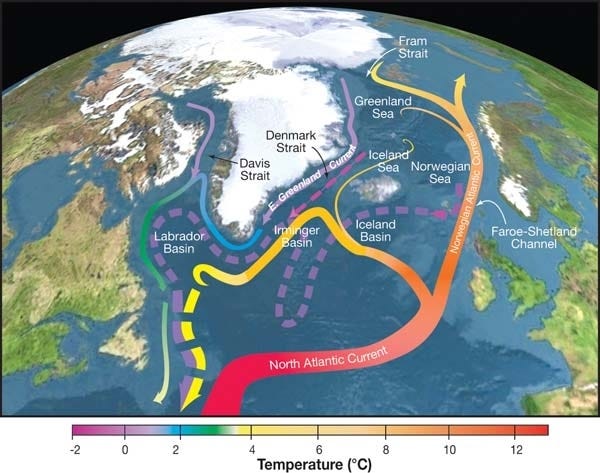
It is why London is temperate at the same latitude as Calgary. It is why Northwestern Europe can sustain the agricultural output that north Canada cannot, the population density, and the industrial base that makes it one of the world’s most productive economic zones.
Put plainly, it is Europe’s heater.
However, the AMOC has weakened by approximately 15% since the mid-20th century (Caesar et al., 2021). This is confirmed across multiple independent datasets. The primary driver is Greenland meltwater: as the ice sheet melts, freshwater enters the North Atlantic, reducing the salinity of surface water, disrupting the density gradient that drives the overturning, and slowing the entire circulation. Greenland melt is accelerating. The weakening trend is not in question.
What is in question is the collapse timeline. A 2023 paper by Ditlevsen and Ditlevsen projected a tipping point around 2057. That paper was challenged by leading oceanographers, including Stefan Rahmstorf, on methodological grounds. The IPCC’s Sixth Assessment Report still classifies full AMOC collapse before 2100 as “unlikely.” Anyone who tells you the science on collapse timing is settled is overstating the case.
The argument I am making in this analysis does not rest on AMOC collapse. It assumes that the current weakening continues. The 15% slowdown already underway compounds Europe’s climate vulnerabilities in ways that general greenhouse gas warming does not produce. That distinction matters, and the rest of this piece turns on it.
The heater may not shut down next decade, but it will increasingly struggle to keep the building warm.
Not Just Warmer: A Compound Failure
Most readers carry a mental model of climate change and Europe: Mediterranean drought, Southern European heat stress, agricultural yield declines, rising seas. That model is correct. What it misses is the redistribution effect that AMOC specifically introduces.
General warming hits Southern Europe. AMOC weakening prevents Northern Europe from compensating. The two effects compound.
Under greenhouse gas warming alone, Northern Europe (the UK, Scandinavia, Ireland, the Low Countries) gets warmer. Agricultural zones migrate northward. The implicit assumption in many climate adaptation scenarios is that as Southern Europe loses productive capacity, Northern Europe partially picks up the slack: new growing regions, extended seasons, northward crop migration. That assumption depends on Northern Europe continuing to warm predictably.
AMOC disrupts it. The weakening of the Atlantic heat pump creates a cooling tendency in Northwestern Europe that runs against the global warming trend. Cold winters, disrupted seasonal patterns, and contradictory climate signals make adaptation planning unreliable.
The South fails to produce. The North fails to compensate.
Europe’s productive agricultural geography narrows from both ends simultaneously.
And then there is the piece of this that almost nobody is discussing: atmospheric blocking. AMOC weakening drives changes in upper-level atmospheric circulation that increase the frequency of blocking events over Central Europe. These are the high-pressure systems that stall over a region and produce extended droughts.
Research published in 2022 identifies Central European drought as “mainly driven” by AMOC dynamics (Drijfhout et al., 2022). Poland and Czech Republic together export nearly €50 billion in agricultural products annually: grains, poultry, processed food. They face a drought risk that sits entirely outside the standard climate narrative. It is the underpriced shock in this analysis.
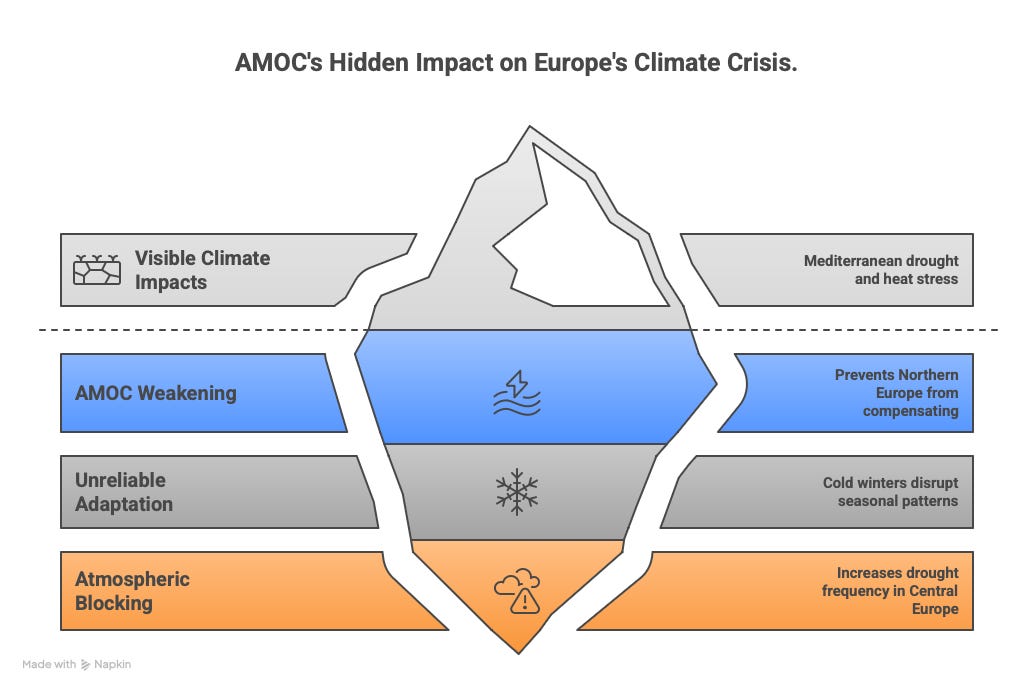
It is not that AMOC causes Europe’s climate crisis. AMOC compounds and redistributesit in ways that general warming projections do not capture. Those specific redistributions land precisely on the productive capacity that Europe is promising its new trade partners.
Act One Is Already Running
The effects described above are not projections. They are already in the data.
Spain and Italy are in structural drought, not cyclical. Olive oil prices surged 58% year-on-year in 2024, a direct consequence of Mediterranean agricultural stress (International Olive Council, 2024). Spain controls 45% of global olive oil supply. The EU-India trade deal includes provisions that reduce olive oil tariffs from 45% to zero. Those provisions become considerably less interesting when the supply they were written for is under existential pressure.
France’s nuclear energy fleet was forced into output reductions in 2022, 2023, and 2024 because river water temperatures were too high for reactor cooling. France is the EU’s largest agricultural exporter. Its nuclear fleet is the backbone of European baseload power. Both are already showing the strain.
Germany’s manufacturers are relocating. Energy costs for European industrial producers now run approximately 2.5 times the US baseline. The EU-India automotive deal commits to 250,000 vehicles per year at reduced tariffs. Those vehicles need to be competitively priced to generate the promised trade flows. They are becoming harder to produce at competitive cost, not because of tariffs, but because of energy.
EU crop losses hit €13 billion in a single year (Eurostat, 2022), a figure that represents goods that were supposed to fill containers bound for New Delhi and São Paulo. Rotterdam, the chokepoint through which EU-Mercosur, EU-India, and EU-Indonesia flows are expected to move, faces a compounding problem: as agricultural volumes under stress shrink at the source, the port’s operational costs rise from a separate direction. Increasing North Sea storm surge frequency driven by AMOC-linked sea level contributions.
This is Act One. The deals were made. Their operative clauses will kick in during Act Two.
The Calendar Problem
Trade deals don’t produce outcomes on signing day. The EU-India FTA, the EU-Mercosur agreement, and the EU-Indonesia deal all project 10 to 15 year operative windows. They begin delivering in the late 2020s and run through the 2030s and into the 2040s.
That is precisely the window in which AMOC-driven effects shift from observable-but-manageable to structural-and-undeniable.
By the early 2030s, Southern European wheat yields are projected to decline 10-25% from baseline before any tipping point is crossed. This is JRC/PESETA IV modeling on the current AMOC slowdown trajectory, not a collapse scenario (Joint Research Centre, PESETA IV).
By the mid-2030s, olive cultivation loses more than half its currently suitable area.
Wine geography migrates northward, but vine crops take 5 to 15 years to reach maturity in new locations: the old zones fail before the new ones produce. That gap is the vulnerability window, and it falls squarely within the operative period of these deals.
France’s nuclear crisis formalizes. Reactor shutdowns become 3 to 4 times more frequent. EU baseload reliability, the foundation on which European industrial competitiveness rests, becomes a structural liability. Every energy-intensive sector is hit simultaneously: German automotive, French aerospace, Dutch chemicals, Belgian pharmaceuticals.
And then there is the UK. The case that sits entirely outside the new FTA framework. Twenty-three percent of all EU agri-food exports go to the UK, approximately €54 billion annually (Eurostat, 2024). Post-Brexit, there is no guaranteed supply commitment; it is a market relationship. If the EU faces domestic food stress, the UK is the first external market deprioritized — not through malice, but through the simple logic that the EU-UK Trade and Cooperation Agreement (TCA), the post-Brexit arrangement governing bilateral trade, contains no agricultural supply guarantees. The newer FTAs with India, Mercosur, and Indonesia carry legal commitments the TCA does not. Britain sits outside that protection.
The UK’s own arable land suitability is projected to collapse from 32% to potentially 7% under AMOC stress scenarios (van Westen et al., 2025). Domestic production failing and primary import source failing at the same time: this is the compound crisis the TCA was not designed to handle.
Three Counterparties, Three Sequences
India: The Hedge That Stops Hedging
Understanding why India signed this deal matters for understanding why it might underperform.
India’s primary motivation was not, as Western commentary often frames it, a desire to replace Chinese suppliers with European ones. The more accurate reading is twofold:
- India wanted to diversify its export markets away from an increasingly unpredictable US trade relationship.
- It wanted to attract European industrial capital and technology into its domestic manufacturing base.
The deal was a market hedge and an investment play, not a supplier substitution strategy.
Both goals are vulnerable to AMOC in the same way.
European purchasing power, FDI capacity, and industrial competitiveness all face structural pressure as climate adaptation costs compound. European capital that was supposed to flow to Indian manufacturing stays home to fund flood defenses, irrigation infrastructure, and grid hardening.
The automotive technology that was supposed to make EU-India trade flows interesting becomes less competitive as European energy costs rise.
The EU market that India was using as a counterweight to US uncertainty turns out to have its own structural trajectory problem.
How the sequence plays out: early disappointment, quiet diversification toward Japan, Korea, and ASEAN as the original hedges.
Then, as the gap between promise and delivery becomes undeniable in the early 2030s, political opposition in India consolidates.
The domestic narrative writes itself.
The deal was oversold, Europe is a declining industrial power, the strategic pivot was misplaced.
India deepens its pragmatic engagements elsewhere, including, eventually, with China. The outcome Western strategy specifically designed to prevent arrives anyway, not through diplomatic failure, but through supply chain math.
Mercosur: The Windfall Trap
The Mercosur case has a counterintuitive structure that makes it the most analytically interesting of the three.
European agricultural stress, in its early phases, benefits Mercosur. When French and Spanish grain yields decline, global commodity prices rise. Brazilian and Argentine exporters see a windfall: beef, soy, and cereals all command better prices. The early years of the deal’s operation, roughly 2027 to 2032, look like a success. Mercosur agricultural exporters lobby hard to maintain and deepen EU market access. Political confidence in the deal grows precisely because of European weakness.
This is the trap.
The deal was sold in Brasília as a comprehensive partnership: FDI, technology transfer, manufacturing sector access, not just an agricultural export channel. While the agricultural sector benefits from EU distress, the industrial and manufacturing sectors are not getting the European investment and market access they were promised. European capital is under structural pressure.
The FDI pipeline runs thinner than projected. The contradiction within Mercosur’s own economic coalition, agricultural exporters benefiting and industrialists disappointed, becomes a source of political instability precisely when EU domestic politics turns protectionist.
By the mid-2030s, EU food security politics forces the invocation of sustainability conditionality provisions. Amazon deforestation clauses become the legal mechanism, but the real driver is domestic pressure to protect European agricultural producers. Mercosur interprets this, correctly, as structural fragility disguised as principled enforcement. Brazil’s political calculus shifts.
The European partnership that was supposed to provide strategic ballast against Chinese influence becomes less reliable than the Chinese infrastructure investment that was always available.
North Africa: The Fastest-Moving Risk
North Africa sits entirely outside the new FTA framework. It has no exception provision or no adjustment mechanism. It has something more fundamental: import dependency for basic caloric intake.
Algeria imports approximately 7 million tonnes of wheat per year, sourced primarily from France. Egypt is the world’s largest wheat importer, at 12 to 13 million tonnes annually, with significant EU sourcing (FAO, 2024). Morocco and Tunisia share comparable structural dependencies.
When French and Spanish yields decline, the effect is not contained within the EU’s trade relationships. Global grain prices rise. North Africa, where food costs represent 30 to 40% of household expenditure in many countries, where youth unemployment is already structurally elevated, and where governance is fragile, faces food security shocks.
This will happen in the same timeframe as the EU-India and EU-Mercosur deals are entering their critical operative periods.
Bread prices contributed to the Arab Spring. The geopolitical consequences of simultaneous food security crises across Algeria, Egypt, Tunisia, and Morocco move faster and more unpredictably than any of the structured counterparty risks above.
The countries most exposed to AMOC’s effects on European trade aren’t the ones that signed deals with Brussels. They’re the ones that didn’t.
The Balance Sheet
The strongest objection to this line of argument is that of adaptation: Europe is not a passive victim. It has the most sophisticated agricultural policy apparatus in the world, a trillion-euro green transition program, Copernicus satellite monitoring, and a track record, in the Netherlands especially, of turning climate vulnerability into technological advantage. The Dutch are the world’s second-largest food exporter from a country the size of West Virginia. If Northern European countries adopt precision agriculture and greenhouse technology at scale, EU export capacity may prove more resilient than this analysis suggests.
The adaptation argument is partially right. It is also, in a specific and quantifiable way, beside the point.
Adaptation requires capital.
Here are the numbers.
The European Commission’s DG CLIMA estimated in January 2026 that the EU needs to spend approximately €70 billion per year on domestic climate adaptation (EC DG CLIMA, 2026). Current adaptation spending is €15 to 16 billion per year (European Environment Agency, 2025).
The annual gap is €54 to 55 billion. EU outward FDI flows in 2024 were €58.8 billion (Eurostat, 2024).
The additional capital needed to fund climate adaptation and the outward FDI pipeline are the same order of magnitude.
Under Stability and Growth Pact constraints the 3% deficit ceiling and the 60% debt ceiling. The EU cannot simultaneously fund domestic adaptation at the required scale, honor green transition commitments, maintain fiscal rules, and grow outward investment to the new trade partners these deals promised.
Fiscal sustainability modeling suggests that without adequate adaptation investment, average EU sovereign debt could be 58 percentage points higher by 2050 (Zenios et al., 2024). The adaptation spend is not optional. It competes with European solvency. And FDI commitments to India, Mercosur, and Indonesia are competing with European solvency.
The adaptation argument doesn’t defeat the thesis. It changes its character. The story isn’t that Europe can’t adapt. It’s that adapting domestically requires redirecting the capital that was implicitly committed to making these trade deals work.
What the Model Was Missing
A word on the exception clause objection, because it will be raised: every trade deal includes food security exceptions, safeguard provisions, and review mechanisms. Both parties know supply conditions change. If the EU invokes these clauses, it is doing something anticipated. This isn’t deal failure. It’s managed adjustment.
The distinction that matters is between occasional exceptions and systematic ones.
Counterparties price individual exception invocations into their deal valuations. What they cannot easily price is a pattern: all major EU trade partners simultaneously discovering that European supply disruption is structural, that exception clauses are being invoked as routine management tools rather than emergency backstops.
India, watching the EU invoke exceptions against Mercosur, recalculates its own deal’s reliability before the same thing happens to it. The exception clause mechanism becomes the vector of contagion, not protection against it.
The market repricing question is the genuinely uncertain part of this analysis. The argument that financial markets will discount European capacity based on long-horizon climate scenarios runs against 30 years of evidence that markets consistently underprice climate risk. The counterargument, that EU regulatory frameworks, specifically CSRD, SFDR, and the ECB’s climate stress testing regime, create mandatory institutional repricing channels that didn’t exist a decade ago, is plausible but not proven.
Early signals are visible: Dutch coastal property markets, Southern European agricultural land valuations, French nuclear utility pricing. Whether those signals generalize before counterparties have locked in strategic positions based on the old model is genuinely uncertain.
My analysis presents it as a risk, not a prediction.
In Conclusion
The EU’s trade deals weren’t wrong. They were built on an incomplete model.
The incomplete part was not the geopolitics. The strategic logic of anchoring India, holding Mercosur, locking in the Indo-Pacific remains sound. After all, it was a result of years of carefully weighing all geopolitical and economic variables.
The incomplete part was a specific compounding mechanism in the North Atlantic that creates a narrowing of European productive capacity precisely during the operative window of these agreements, and that redirects European capital away from the external commitments these deals imply.
What needs to be built into the next generation of trade architecture is not alarm but stress-testing. Supply commitments should be evaluated against all local and global climate phenomenons like AMOC, not just greenhouse gas baselines.
Adjustment mechanisms need to go beyond food security exception clauses to include structured investment guarantees that remain operative even when European domestic capital faces pressure.
For India and Indonesia particularly, the window to pre-empt the “EU underperforms” narrative is the next three to five years, before the trajectory becomes undeniable and political opposition to the deals consolidates around a story of European decline.
It is also worth being clear about what each counterparty was actually buying. For all parties, these deals were a diversification strategy.
India was hedging its exposure to US trade volatility.
Mercosur was building a market beyond China’s orbit.
Indonesia was securing technology partners to complement its existing regional ties.
Each counterparty placed a bet on European reliability as a stable alternative anchor. That bet, and not just the specific trade flows it was designed to generate, is what AMOC puts under pressure.
The deals were designed to reduce fragmentation in a fracturing world order. The risk, if the model remains incomplete, is that they accelerate the very fragmentation they were built to prevent.
What makes this moment consequential is the asymmetry of timing. The tipping points in the science and the tipping points in counterparty confidence are both approaching, and neither waits for the other. The window to close the gap between what was promised and what can be delivered is open now. It will not stay open indefinitely.
If you enjoyed reading this analysis and think of someone who would as well, please consider sharing. I look forward to your thoughts and critique. It helps me do better.


Leave a Reply